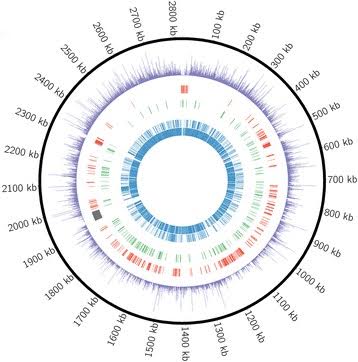
Welcome to fUtility (a utility for fitness). fUtility is an online tool for Tn-Seq data analysis and visualization. It has been designed to work with the phage-based platform for next gen sequencing of high-density transposon libraries described in Santiago et al. 2015. BMC Genomics. We have used this platform to identify genes conferring an increase or decrease in fitness in the presence of a set of antibiotics (both clinically-used antibiotics and probes). This dataset allows us to nominate mechanisms of action for compounds with an unknown target and to predict functions for hypothetical genes.
Download the tool here. This tool requires Java (version 7, at least) to be installed on your machine. Run it with "java -jar futility.jar". It will start a local web server, and if go to this link: http://localhost:9000/futility.html you'll see the same tool that we provide above.
Note: If the server fails to start up with the message "Address already in use", you can start the tool on a different port by passing a new port number to the command. For example, try "java -jar futility.jar -p 7777" (this will mean you need to go to an address like http://localhost:7777/futility.html).
Note: On some operating systems (for example, Windows), the Java Virtual Machine starts up with a small heap. This can cause memory errors when analyzing data. In that case, it makes sense to run the jar and set the heap space to a higher value, like "java -Xmx2048m -jar futility.jar". A recent update has changed futility to store the data session on disk, reducing the need for a large heap.
For more details on the architecture of the tool, see this document.
There are three components - a data management interface, a fitness comparison table, and a genome viewer. These items can be imported, and if you want to replace them or reduce the memory usage of your machine, they can be removed.
This interface is used to load data sets. There are three types of data:
This file is a tab-separated-value (TSV) file. The tabs are gene name, start position, end position. This is used to map labels to the gene and lookup features at a given gene.
This is an IGV file containing control data. We'll derive a mapping of "heights" from the numbers of reads, and use this data for analyzing experiments.
This is also an IGV file. Using the linked control, we derive the same height mapping and also analyze some features of the data for comparison against other experiments.
To explore our curated datasets, simply click on the gene of interest from the dropdown in the top-left. Data can be sorted by clicking on any of the column headers. To view the raw data for a gene, click on the compound of interest, which will take you to…
To compare raw data between treatments, simply click “Add treatment”. Raw data is colored by height to help identify possible outliers. You can zoom in and out of the raw data graphs by scrolling, and simply type in your gene of interest to move to another location in the genome. To download data, visit here. To compare your data to our curated set, upload a SAM-formatted file, and click analyze.
Once you have the tool open, click the "Help" tab.
fUtility was designed by Suzanne Walker’s lab at Harvard Medical School, and was implemented by Brian Fults.
For questions/comments on experimental protocols, please email suzanne_walker at hms.harvard.edu.
For questions/comments on the webtool, please contact Marina Santiago.